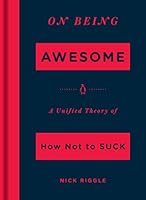
On Being Awesome
by Nick Riggle
Read as
ebook
My Review
The author of this book was a pro skater who became a philosopher and is working at a university. It’s pretty awesome to see how these two aspects of this person come together in this book. So nice to see such a unique perspective!
What I didn’t like was how even though the author explain later on in the book how you can’t really be awesome and that awesome is something you do, the hierarchical viewpoint of awesomeness being and attribute of a person that makes them better than others is kinda expressed in this book and that’s kinda sucky.
Overall, it was a fun read that dragged on a bit but was pretty good. Not awesome, but good.
Highlights
- A person only plays when they are a person in the full sense of the word, and they are fully a person only when they play. —Friedrich Schiller
- If you obey all the rules, you miss all the fun. —Katharine Hepburn
- When we break out of our norm-governed roles by expressing ourselves, we can create what I call a social opening.
- Social openings are therefore also a kind of self-opening, because they can provide opportunities for self-expression, exploration, cultivation, and appreciation.
- There are many means of expression that allow us to break out of our social roles and norms: remarks (compliments, jokes), gestures (making faces, flashy movements), offerings (gifts), acts of kindness, playfulness, and displays (outfits), to name a few.
- In short, success in creating social openings requires that you be sensitive to (1) the ways in which you break or set aside the social norms, and (2) the appeal of the individual you present, which in turn requires that you be aware of context and sensitive to the individual to whom you are expressing yourself.
- Individuals gain definition as they cultivate ways of exploring, playing, and seeking that they like and value—they gain not just the ability to laugh, but a sense of humor; not just the ability to empathize, but a refined sense of care and concern.
- Social openings are essentially opportunities for the mutual appreciation of individuality, allowing us to express, attribute, and cultivate our individuality beyond whatever is required to play out the script written in the social code, or to carry on in our everyday habits and routines.
- Being invested in the pursuit of individuality is part of what it is to really live.
- Awesome people inject life into things: They create and carry out social openings, instituting communities and cultures in which people can develop, display, and appreciate the individual each other is or aspires to be.
- We perform an awesome action when: we approach a situation normally governed by a social role or norm; the spirit of awesomeness flows within us; we harness this motive and break out of (or creatively riff on) the social role or norm; and we thereby create a social opening and give our copeople an opportunity to suck or not suck.
- Success in creating social openings requires sensitivity to individuality.
- Central to the ethics of awesomeness is a range of aesthetic categories, or categories that are essential to art or beauty: creativity, individuality, style, imagination, and play.
- The person widely credited with inventing the high five is Glenn Burke (1952–1995), a black baseball player and gay trailblazer, recognized by the Baseball Hall of Fame as Major League Baseball’s first gay player.
- On October 2, 1977, at Dodger Stadium, Dusty Baker had just hit his thirtieth home run of the season. Burke was up to bat next, and when Baker rounded third base and approached home plate, Burke was waiting to greet him. “His hand was up in the air, and he was arching way back,” Baker recalls. “So I reached up and hit his hand. It seemed like the thing to do.”
- What the high five expresses, at least in its original form, is not the mutual appreciation of achievement but the feeling we get upon the achievement of mutual appreciation.
- The ultimate good in the ethics of awesomeness, then, is not some status that accrues to an individual, like moral virtuosity or sainthood. It’s a positive state that takes two to institute, inherent in copersons and crews. Awesomeness essentially has others in mind—particularly other individuals.
- Pretty much everything, given the right context, can be employed in the ethics of awesomeness as long as it plays a valuable role in the appreciation of individuality—even
- A truly awesome society and culture is one whose expectations are fair and equal across race, gender, and sexual orientation—and it’s one that is sensitive to people’s differing approaches to flourishing in the ethics of awesomeness.
- The ethics of awesomeness concerns the ways of being and responding to creative community builders, who give us models, ideas, and motivation for awesomeness, and whose creation or deployment of cultural artifacts—bands, booze, art, and shoes—provides a locus for the cultivation and mutual appreciation of individuality.
- Wack people not only decline social openings, but are actively or symbolically against them for no good reason.
- Instead of preference dictating, invite your potential coperson over for a meal that embodies your food values, suggest a film or documentary that conveys the value of your social or political views, or tell a story that reveals why you love the things you love so much.
- Don’t forget your Emily Post: “Alas it is true: ‘Be polite to bores and so shall you have bores always round about you.’”*
- Trust the perceptiveness of your copeople and know that the appreciability of your individuality will emerge over time.
- He tells us that assholes are people who (mistakenly) feel they are entitled to special advantages in social situations, and they systematically act on this feeling to further their ends and immunize themselves against the legitimate complaints of others.
- We can wear masks of ourselves, ones that highlight or accentuate our best features—makeup, clothing, tattoos, and our overall style do this. Fake-ass people wear masks that aren’t of themselves.
- That’s exactly what Dusty Baker did when Glenn Burke held up his hand for the iconic high five in 1977. When asked whether it was in fact he who invented the high five, Baker said, “No, I didn’t invent the high five. All I did was respond to Glenn. That’s all I did.”* Baker tried to downplay his role, but being down mustn’t be downplayed. The ethics of awesomeness is all about taking two (or more) to tango.
- Sometimes we get justifiably angry, incensed, outraged, or annoyed, and when we express these feelings and someone tells us to “be chill” or “chill out,” they might be trying to silence our legitimate voice by appealing to what is otherwise a social virtue.
- The first rule of being chill is keeping an open mind and cultivating sympathetic insight into the interests and values of other individuals.
- The second way to be down is to be up.
- David Alger’s first rule of improv is essentially to be game. He tells improv actors to say, “Yes! And …”
- And after all, being evaluated as sucky isn’t the end of the world—as good as it may be, awesomeness isn’t the only dimension of value or the only ideal worth having.
- Ideals shift and change not only at the individual level but also at the level of society and culture. But the fact that ideals are like this is no reason to deny their importance, or to shy away from trying to articulate them, understand their origins, and evaluate their significance,
- He performed in a racist era, when whites imposed racist norms on black performers—actors, comedians, musicians, and others. They were expected to always smile on stage, entertain, and generally be jovial and accepting of whatever their white audience wanted.
- Lester Young resisted this Uncle Tom culture in part by adopting a detached and mellow style and signaling his intention to not observe the “rules.”
- As cultural historian and Tulane University English professor Joel Dinerstein writes, “Young’s whole life was self-consciously dedicated to being original—in his music, in his mannerisms, in his style of detachment—as if being original was the vital force of human life itself.”* His individual self-expression was so original and appealing that other people—actors, suburban youth, people without a cause, and even many jazz musicians—could not help but adopt it for themselves.*
- Social and political theorist Emma Goldman appreciated this problem as early as 1911: “The problem that confronts us today, and which the nearest future is to solve, is how to be one’s self and yet in oneness with others, to feel deeply with all human beings and still retain one’s own characteristic qualities.”
- It’s more illuminating to think of style as the expression of our personal ideals—not simply the personality each person has but the individual he or she aspires to be.
- “Awesome projects … tend to challenge and expand our understanding of our individual and communal potentials. They bring communities together, casting aside social inhibitions and boundaries for a moment. They spark an instant of joy and delight and inspire a long-term hope for a more Awesome future.”
- Over eleven months in 1979 artist Mierle Laderman Ukeles shook the hands of every New York City sanitation worker—all eighty-five hundred of them across five boroughs—thanking them for their essential and nearly universally underappreciated work.
- Awesome art is the art of social openings—of creating, cultivating, and encouraging them, but also of performing, theatricalizing, depicting, and representing them.
- Our enthusiasm for the kind of connection and culture that awesomeness fosters is all too easily exploited, televised, recorded, and made into a spectacle that threatens to turn awesomeness into something that we simply stare at, share on social media, and move on.
- promise of new technology to help us really connect. When used in the right way, social media and new technology can help us cultivate the awesomeness we aspire to.
- Truly awesome people don’t ask, “How can I be more awesome?” They ask, “What can I do to create more awesomeness?”
- The advice “Be awesome!” is misleading, for being awesome is a way of doing things and not a thing to do.
- If you’re living a life, developing a style, becoming the kind of person who aims to make people laugh, think, play, imagine, smile, care, strive, or empathize, then you’re probably attuned to the ethics of awesomeness.
- Awesome culture gives us a picture of a person who is creatively generous, egalitarian, nonconformist, socially curious, open, innovative, cooperative, playful, and sympathetically attentive to individual style. It also gives us an image of activities, pursuits, and forms of society that embody and encourage these qualities.
- The imagination must be cultivated; the culture must be imagined.